Gris Marsala's indefinite suspension from religious life
La piel del tamborGris Marsala's indefinite suspension from religious life leaves her neither fully at home in her religious community nor formally separated from it. In Seville she lives independently and teaches art, while remaining a member of her order; the suspended status follows a personal crisis that exposed the distance between a life of disciplined obedience and the life she had never allowed herself to choose. Her story makes suspension more than an administrative interval: it is the unsettled space in which she tries to recover memory, identity, and agency without claiming that the past can simply be undone.
Status and life in Seville
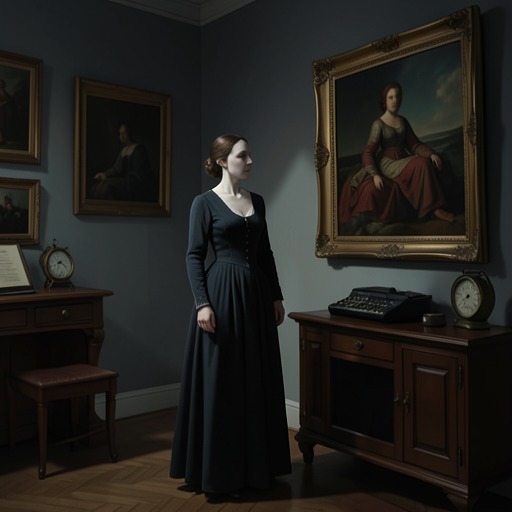
A report from Rome describes Gris as having entered a religious order at eighteen, studied architecture and fine arts at the University of Los Angeles and in Seville, Madrid, and Rome, and gone on to teach art for seven years. She later directed a religious college for university women in Santa Barbara for four years. Following a personal crisis accompanied by health complications, she received an indefinite temporary dispensation. By the time she had spent three years in Seville, she was supporting herself by teaching art to American students, maintaining only discreet contact with a local residence of her order and living in a private home. The report records that she had not requested separation from religious life; her status is a suspension, not a departure.
The administrative account also specifies what it does not establish: Gris had no recorded special training in computing. That detail sits beside the dossier’s account of her education and professional history, distinguishing the known outline of her life from assumptions that might otherwise be made about her. Her present situation remains defined by partial connection—to her order, its rules, and religious life—rather than by a clean break.
Crisis and the limits of obedience
Gris explains that she had remained faithful to religious rules throughout her life and continued to do so in Seville, though she calls her independent circumstances a small breach of the vow of poverty. The crisis behind her suspension, she says, was an illness of the spirit more than a physical illness. While directing the college in Santa Barbara, she fell in love with her bishop, or believed she had; she describes the distinction as immaterial. She had spoken with him only about professional matters, but realized what was happening when, at forty, she found herself discreetly putting on eye makeup in front of a mirror because he was expected to visit.
She shows Quart the scar on her wrist and rejects the interpretation that she had tried to kill herself. She characterizes the injury instead as an outburst of anger and desperation. After leaving the hospital, she sought advice from her superiors. Their answer, as she recounts it, was to recommend prayer, discipline, and the example of Saint Thérèse of Lisieux. Gris’s account thus gives the crisis a personal and institutional dimension: she experienced a severe emotional rupture, while the response she received directed her back toward religious discipline rather than toward a different way of understanding her desires.
Her reflections on the mirror sharpen the conflict. From novitiate onward, she had been taught that mirrors in a religious woman’s cell were dangerous and that her reflection should be in the rosary and prayer book. A nun, she says, owns nothing—not even clothing or intimate necessities, which are supplied by the community—and the salvation of her soul is held to admit no individualism or personal decisions. Against that prescribed self-effacement, the moment of seeing herself prepare for the bishop’s visit becomes an instance of recognition: she saw the desire and divided life she had been trained not to name.
Memory, vocation, and lost autonomy
Gris links memory to freedom. She tells Quart that she has been made an orphan several times and calls orphanhood a form of slavery: memory gives a person steadiness, a sense of who she is and where she is going, while its absence leaves her at the mercy of whoever arrives and claims her as a daughter. Her insistence that defending memory is defending liberty gives her presence in Seville a purpose beyond waiting for an institutional decision. The past is not merely an archive of injury; recovering it can restore some capacity to decide what her life means.
She also places her religious vocation in the context of childhood. Her father was jealous and domineering, and she feared disappointing him. She suggests that some women’s vocations may grow amid prolonged anxiety under a father’s control, and recalls being taught from girlhood to distrust men and guard against losing control around them. At eighteen, she renounced earthly love; at forty, she asks whether that choice was right or whether it was irresponsible and foolish. Her deepest accusation is not simply that she sacrificed romance, but that fear of displeasing her father and fear of sin led her to carry what she calls the greater sin: never having lived a life truly her own. She asks what can be done when such questions arrive too late, without receiving a definitive answer.
Relations with Quart and the church
Gris warns Quart that certain places and people cannot be encountered without consequence. She names Seville, Nuestra Señora de las Lágrimas, Príamo Ferro, and Macarena Bruner, then observes that he, like Ferro, seems to have little to lose. Her warning makes her own suspension part of a wider encounter with people whose commitments and vulnerabilities exceed the formal categories by which the Church or its authorities might define them. She recognizes in Quart an affinity with Ferro while cautioning him that the city and church can draw him into a conflict whose costs he may not yet understand.
The church’s precarious position supplies a concrete setting for that warning. An old privilege, confirmed in 1687, requires a Thursday Mass for the soul of Gaspar Bruner de Lebrija; the church remains protected from secularization and demolition so long as the obligation is fulfilled. The archbishop has sought Ferro’s suspension from office, but the request to Rome is slow-moving, and the Thursday service is watched by an archiepiscopal representative and a notary paid by Pencho Gavira, each alert to a lapse. Gris’s warning about the church is therefore not abstract. Its survival depends on a recurring ritual and a vulnerable priest, while ecclesiastical discipline and redevelopment interests press against them.
Meaning of suspension
Gris’s position contrasts with Ferro’s defense of the church. He argues that even if he himself has faith or lacks it, the people who come to Nuestra Señora de las Lágrimas do believe, and that their need for consolation justifies the church’s existence. He describes its Baroque art as a means of sustaining hope through images and ritual, even while acknowledging the moral danger of replacing thought with consolation. Gris’s own story likewise refuses an easy opposition between religious discipline and personal freedom: she remains faithful to rules, but speaks plainly about the life those rules and her own fear prevented her from living.
Her status is thus both an institutional condition and an unresolved personal reckoning. The report from Rome supplies dates, offices, studies, and the fact that she has not sought separation; her own testimony gives those details their human weight. She remains attached to religious life without being restored to its ordinary structures, and her recovery of memory does not erase the scar, the lost years, or the question of what a freely chosen life might have been. In Seville, that suspended interval becomes a space from which she can name what obedience cost and begin to judge her past in her own words.